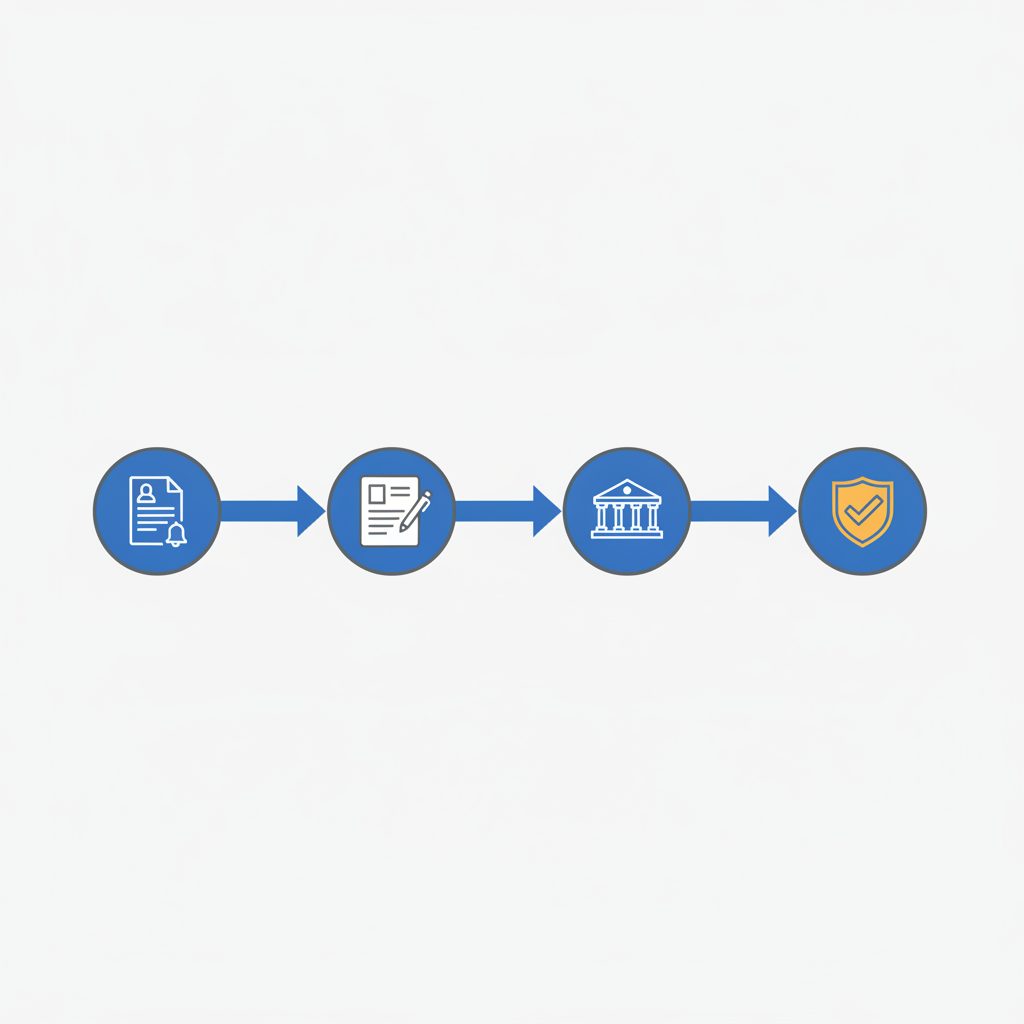














Every year, millions of people in India sit for a government exam. Most have only a hazy idea of what happens after they hit submit. That gap is where confusion, wasted attempts, and outright scams thrive. Government job recruitment in India is not one process. It is a family of processes run by different bodies, all built around the same spine: a public notice, an application window, one or more exams, a document check, and a final merit list.
This guide walks that spine end to end. It is evergreen on purpose. We will not tell you which posts are open today or when the next exam falls, because those change constantly and anyone promising a fixed date is guessing. What does not change is the machinery. Learn it once and every future notification reads faster.
Who actually recruits: the main bodies
There is no single “government jobs department.” Hiring is split across agencies, each owning a slice.
- UPSC — the Union Public Service Commission runs the Civil Services Examination and several other central posts. Small numbers, brutal competition.
- SSC — the Staff Selection Commission fills a huge volume of Group B and Group C posts across ministries through exams like CGL and CHSL.
- IBPS and SBI — banking recruitment. IBPS conducts common exams for public sector banks; SBI runs its own.
- RRB — Railway Recruitment Boards hire for one of the largest employers in the country.
- State Public Service Commissions — each state has its own PSC for state administrative and departmental jobs.
Defence, PSUs, teaching, police, and dozens of departmental boards add more lanes. The point is simple. Before you prepare, know which body owns the job you want, because each has its own calendar, syllabus, and rules.
The recruitment cycle, step by step
Strip away the names and almost every central and state hire follows the same seven stages.
- Notification. The recruiting body publishes an official notice with the number of posts, eligibility, fees, exam pattern, and a link to apply. This is the only document that matters. Learning to read one properly is a skill in itself.
- Application window. You register on the official portal, fill the form, upload documents, and pay the fee. Miss the closing date and nothing else counts.
- Admit card. A hall ticket is released before the exam with your centre and roll number. It is downloaded from the same portal, never emailed by a stranger.
- Examination. One tier or several. Many exams have a preliminary screening, a main exam, and sometimes a skill or physical test.
- Result and cut-off. Scores are published against category-wise cut-offs. You clear a stage or you do not.
- Document verification. Originals are checked against what you claimed — age, qualification, category, identity.
- Final merit list and appointment. Ranks are compiled, posts allotted, and an offer follows.
The whole cycle can run several months to over a year. Patience is part of the job description.
Eligibility: the four gates
Before ability, there is eligibility. Four checks decide whether the system will even look at your form.
Age
Every post sets a minimum and maximum age, calculated as of a cut-off date stated in the notice. Reserved categories get relaxations — commonly a few extra years for OBC and more for SC/ST, with specific rules for persons with disabilities and ex-servicemen. The exact numbers vary by exam, so read the table, do not assume.
Qualification
Some posts need a graduate degree in any discipline. Others demand a specific one — engineering, law, a particular science. A few Group C posts ask only for Class 10 or 12. Applying without the stated qualification wastes your fee and your attempt.
Nationality and category
Most posts require Indian citizenship. Reservation applies across SC, ST, OBC, EWS, and other notified categories, and you must hold a valid certificate in the correct format to claim it. Our breakdown of age, qualification, and category rules goes deeper on the paperwork.
Reservation and how merit lists work
India reserves a share of government posts for SC, ST, OBC, and EWS candidates, alongside horizontal reservation for persons with disabilities, women in some states, and ex-servicemen. Reservation does not mean a separate easier exam. Everyone sits the same paper. What differs is the cut-off applied to each category and the number of seats ring-fenced for it.
A merit list is built by ranking candidates within their category against those category seats, while unreserved seats go to top scorers regardless of category. This is why two people with the same score can land different outcomes — the seat they are competing for is not the same seat.
Central versus state jobs
Central government posts, through UPSC, SSC, banks, and railways, often mean a transferable, all-India role. State PSC jobs usually keep you within one state and its language and administrative context. Neither is better. They suit different lives. If you want to stay near home, the state route deserves a hard look — start with our guide on finding and applying for state government jobs.
Where people go wrong
The failures are predictable, which means they are avoidable.
- Chasing every notification. Spreading across ten exams beats focus on none. Pick a lane.
- Ignoring the fine print. Age cut-off dates, attempt limits, and certificate formats sink more applications than weak preparation.
- Trusting unofficial sources. Real notifications live on official commission and department portals. If a “job” asks for money to secure a seat, it is a scam. Read how to spot fake recruiters before you pay anyone anything.
A realistic preparation mindset
These exams reward consistency over intensity. A candidate studying four focused hours daily for a year usually beats one who crams for a month. Understand the exact pattern of your target exam, build from previous papers, and treat mock tests as diagnostics, not decoration.
Two specific exams are worth studying as case studies because their structure teaches the whole system. Read how SSC CGL works for the volume-hiring model, and how bank recruitment through IBPS, SBI and RBI works for the banking track. Between them they cover most of what the machinery does.
The one habit that changes everything
Read the official notification, in full, before you prepare for anything. Not a coaching summary. Not a forwarded message. The actual PDF from the actual body. It tells you the posts, the eligibility, the pattern, and the timeline in the recruiter’s own words. Everything in this guide is context for that single document. Learn to read it well and government job recruitment stops feeling like a maze and starts looking like a checklist.