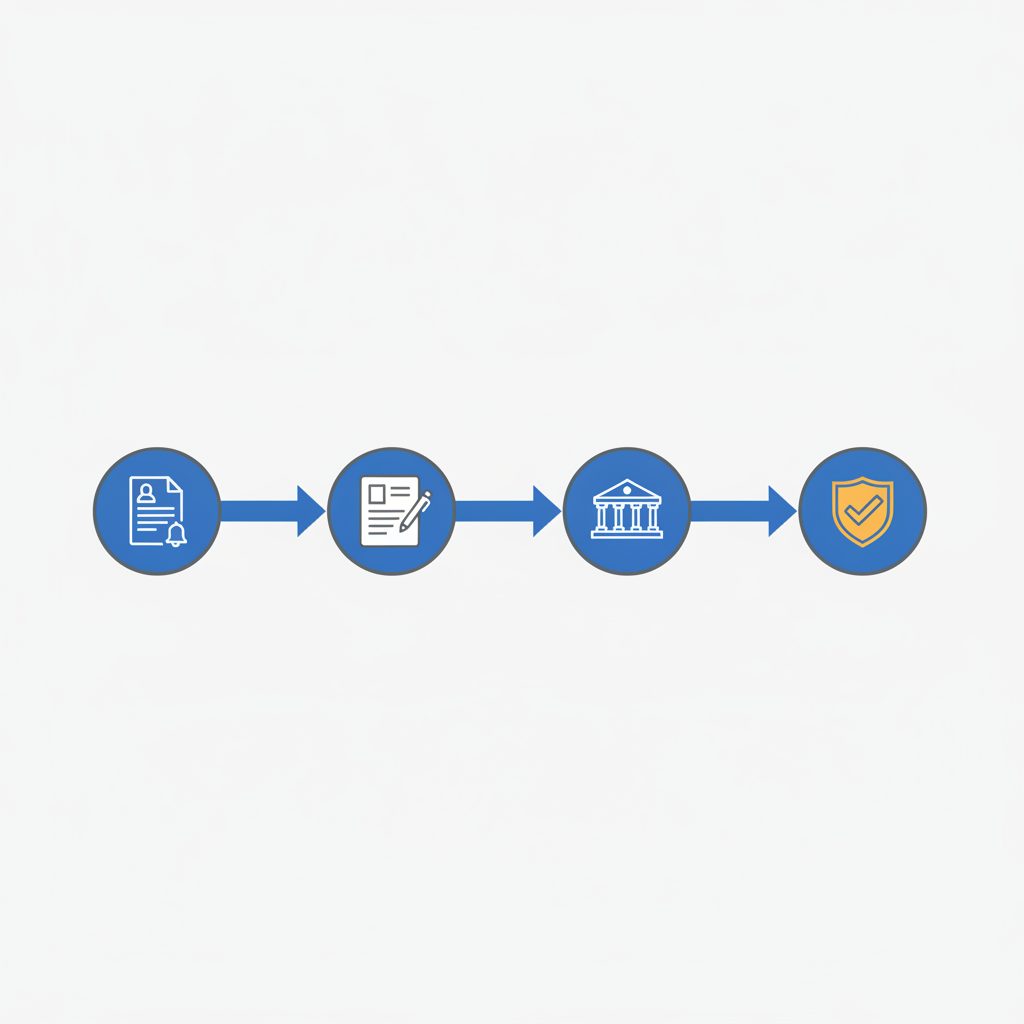














The single most useful skill in a government job hunt is not solving quant fast or memorising current affairs. It is reading a government job notification properly. That PDF is a legal document. It decides whether your application survives, and most rejections happen not in the exam hall but in the paperwork, weeks earlier, over a detail the candidate skimmed.
A notification runs anywhere from ten to sixty pages of dense officialese. Coaching channels condense it into a slick post, and that summary is where mistakes are born. This guide teaches you to read the original the way a careful clerk would — section by section, looking for the traps.
Think of it like a contract you are about to sign. You would not sign a loan agreement off someone’s verbal summary. A recruitment notice deserves the same caution, because the consequences of missing a clause are just as real: a rejected form, a lost fee, an attempt burned. The good news is that these documents, however intimidating, follow a predictable structure. Once you know the map, thirty minutes of careful reading covers it.
Why the official notification is the only source that counts
Every claim you have heard about an exam — posts, eligibility, fees, pattern — comes from one place: the notification published by the recruiting body. Forwarded WhatsApp images, YouTube thumbnails, and aggregator sites all copy from it, and copies introduce errors. When a summary and the PDF disagree, the PDF wins, every time. So go to the source. If you are still learning the wider system, our overview of how government recruitment works in India gives the map this document fits into.
The sections that decide your fate
Open any notification and you will find the same anatomy. Read it in this order.
1. Post details and vacancies
Which posts, how many, and under which department. Vacancy numbers are often marked provisional, meaning they can rise or fall. The category-wise split matters here too — it shows how many seats fall under each reserved category.
2. Eligibility criteria
The heart of the document. Three things to pin down.
- Age. Minimum and maximum, calculated as on a specific cut-off date, with relaxations for reserved categories. That cut-off date is everything — being eligible today means nothing if you cross the limit by the stated date.
- Qualification. Exactly what degree or certificate, and by when you must hold it. Some allow final-year students to apply; many do not.
- Category and other conditions. Which certificates you need and in which format.
The full logic of these gates is worth a separate read on age, qualifications and categories.
3. Application fee and payment
How much, who is exempt, and the payment modes. Many bodies waive or reduce the fee for women and reserved categories. Note the fee deadline separately — sometimes payment closes a day after the form does.
4. Important dates
Opening date, closing date, fee last date, and the tentative exam window. Write the closing date somewhere you cannot ignore it. Portals slow to a crawl on the last day, and a system that hangs at 11:55 pm does not grant extensions.
5. Exam pattern and syllabus
Number of stages, marks, duration, negative marking, and the subject-wise syllabus. This section drives your entire preparation, so photograph it and keep it in front of you while you study.
6. Selection process
The path from application to appointment — which tiers, any skill or physical test, document verification, and how the final merit list is built. Some posts weight an interview; many central exams have removed interviews for lower posts entirely.
7. How to apply
The official portal link, document specifications, photo and signature dimensions, and submission steps. Upload a photo in the wrong size and the form can be rejected on a technicality.
The fine print people skip and regret
Buried clauses cause the quiet rejections.
- Number of attempts. Some exams cap how many times you can appear, often varying by category.
- Bond or service conditions. A few posts require you to serve a minimum period or accept a bond.
- Domicile requirements. State jobs frequently ask for a domicile certificate of that state.
- Physical standards. Police and defence roles set height, chest, and vision norms that are non-negotiable.
- Probation and posting terms. The initial probation period, likely location, and whether the role is transferable all-India or fixed to a region.
None of this is hidden to trick you. It is simply in a document most people do not finish reading. Consider a common trap: a candidate who has cleared graduation results but has not yet received the degree certificate. Some notifications accept a provisional certificate; others insist on the final one by the closing date. Read that clause and you know whether to apply now or wait. Skip it, clear the exam, and you can still be knocked out at verification for a document you could have arranged in time. The exam is the visible contest. The paperwork is the silent one, and it eliminates people just as effectively.
A checklist before you hit submit
- Confirm your age against the exact cut-off date, not today.
- Confirm your qualification matches, including the deadline to possess it.
- Confirm you hold every certificate you are claiming, in the right format.
- Note the closing date and fee last date as two separate deadlines.
- Read the exam pattern and save the syllabus.
- Check attempt limits, domicile, bond, and physical standards.
- Match your photo and signature to the stated dimensions.
Guarding against fakes
Because notifications carry authority, scammers imitate them. A fake notice looks official, links to a lookalike portal, and asks for a fee to a private account. Genuine bodies never route application fees to an individual, and never release admit cards through random emails. If anything asks you to pay to “guarantee” selection, close the tab and read our guide on avoiding job scams and fake recruiters.
Read once, apply right
Thirty minutes with the original notification saves you an entire wasted exam cycle. The document is boring on purpose — it is legal text — but it answers every question you have and several you did not think to ask. Whether you are targeting SSC CGL or any other post, the habit is the same. Open the PDF. Read every section. Then, and only then, fill the form.